


Best Degrees After FSc Pre-Medical Without MDCAT in Pakistan
- August 11, 2026
- 939
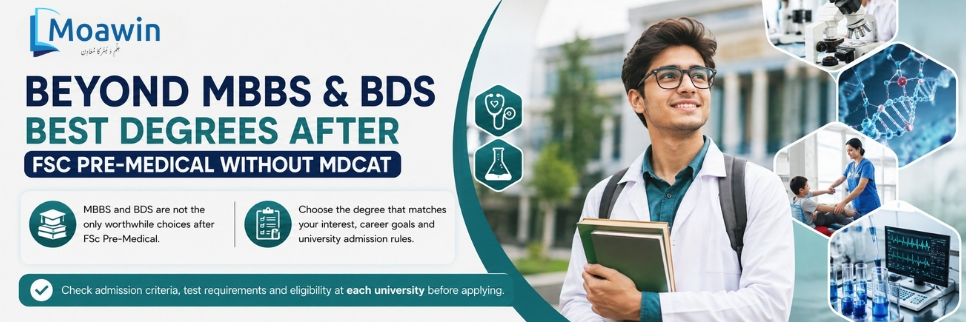
MBBS and BDS are not the only worthwhile choices after FSc Pre-Medical. If you did not take MDCAT, could not secure the required score, or simply do not want to become a doctor or dentist, you can still choose from several healthcare, laboratory, rehabilitation, science, technology and interdisciplinary degree programs in Pakistan.
The right option depends on what you enjoy studying and what kind of work you want to do. Admission rules also differ by university: a program may accept Pre-Medical students at one institution but require a separate test, higher marks or an additional course at another. This guide explains the strongest options and the checks students and parents should complete before applying.
Quick Answer: Can FSc Pre-Medical Students Get Admission Without MDCAT?
Yes. MDCAT is the admission test used for MBBS and BDS under PM&DC rules; it is not automatically required for every degree connected with health or science. Many universities admit Pre-Medical students to DPT, Pharm-D, BS Nursing, allied health, biological sciences and other programs through their own merit criteria or admission tests. Always confirm the current rule from the university prospectus and the relevant professional council before paying a fee.
Comparison of Degrees After FSc Pre-Medical Without MDCAT
| Degree | Typical Duration | Main Study Area | MDCAT Requirement | Suitable For | Possible Career Direction |
|---|---|---|---|---|---|
| DPT | 5 years | Movement and rehabilitation | Usually not PM&DC MDCAT; university rules apply | Patient care and rehabilitation | Hospitals, rehabilitation and clinics |
| Pharm-D | 5 years | Medicines and pharmacy practice | Usually no MDCAT; separate test may apply | Chemistry, biology and medicines | Hospital, community and industry pharmacy |
| BS Nursing | 4 years | Nursing and patient care | Not generally MDCAT; institutional selection applies | Direct and continuous patient care | Hospitals and community health |
| BS MLT | 4 years | Diagnostic laboratory testing | Usually no; university test may apply | Careful laboratory work | Hospital and diagnostic laboratories |
| BS Medical Imaging | 4 years | Imaging equipment and procedures | Usually no; university rules apply | Technology in clinical settings | Imaging departments and centres |
| BS Nutrition and Dietetics | 4 years | Food, nutrition and health | Usually no | Nutrition and preventive health | Hospitals, public health and food sector |
| BS Biotechnology / Microbiology | 4 years | Biological science and research | Usually no | Research and laboratory science | Research, quality control and industry |
| BS Psychology | 4 years | Human behaviour and mental processes | No | Behaviour, communication and research | Community, education, HR and further clinical study |
| BS Public Health | 4 years | Population health and prevention | Usually no | Health systems and communities | Public programs, research and NGOs |
| BS Computer Science | 4 years | Programming and computing | No; maths deficiency may apply | Logic, problem-solving and technology | Software, data and technology roles |
Best Degree Options After FSc Pre-Medical Without MDCAT in Pakistan
1. Doctor of Physical Therapy (DPT)
DPT focuses on movement, physical function, pain management and rehabilitation. Students commonly study anatomy, physiology, biomechanics, therapeutic exercise and supervised clinical practice. It suits those who want regular patient interaction but are more interested in recovery and mobility than medical diagnosis.
The usual duration is five years, and FSc Pre-Medical is a common eligibility route. PM&DC’s MDCAT is not a nationwide DPT requirement, although a university may conduct its own test or use a central admission test. Graduates may work in hospitals, rehabilitation centres, sports settings and physiotherapy clinics within the scope allowed by applicable regulation.
Consider: The word “Doctor” in the degree title does not make a DPT graduate an MBBS physician. Check clinical placement quality and current professional registration requirements before enrolling.
2. Doctor of Pharmacy (Pharm-D)
Pharm-D is a five-year professional pharmacy degree covering pharmacology, pharmaceutics, medicinal chemistry, pharmacognosy, pharmacy practice and the safe use of medicines. It may suit students who enjoy biology and chemistry and want to understand how medicines are developed, supplied and used.
FSc Pre-Medical is normally accepted. For example, Dow University’s published criteria have required Pre-Medical or equivalent qualifications and a separate entry test rather than MDCAT. Requirements vary, so confirm both the university criteria and the Pharmacy Council of Pakistan status of the program. Career directions include hospital and community pharmacy, pharmaceutical manufacturing, quality assurance, regulatory work and research.
Consider: Admission to a university is not enough on its own; verify that the specific Pharm-D institution and intake are recognized or permitted by the Pharmacy Council of Pakistan.
3. Generic BS Nursing
BS Nursing is a four-year degree built around direct patient care, clinical decision-making, community health, pharmacology and supervised hospital practice. It is appropriate for students who can communicate calmly, work in teams and remain responsible during demanding clinical situations.
The Pakistan Nursing and Midwifery Council lists FSc Pre-Medical or equivalent with Biology as an admission route and publishes its minimum criteria. Individual colleges may set higher merit, an age condition, an interview or a test. Students should apply only to a PN&MC-approved institute and verify student pre-registration arrangements. Work settings may include hospitals, community services, teaching and specialised nursing after further training.
4. BS Medical Laboratory Technology
Medical Laboratory Technology teaches students how clinical samples are processed and tested in areas such as haematology, microbiology, clinical chemistry, histopathology and blood banking. It is a strong fit for careful students who prefer evidence, instruments and laboratory procedures over continuous bedside care.
The degree usually takes four years and commonly accepts FSc Pre-Medical. MDCAT is not normally required, but the institution may use its own merit or entry test. Graduates may work in hospital laboratories, diagnostic centres, blood banks, public-health laboratories and research settings. Before applying, inspect the program’s laboratory facilities, practical hours, hospital attachment and relevant accreditation status.
5. BS Medical Imaging Technology
This degree combines patient handling with the technical side of diagnostic imaging. Coursework may cover anatomy, imaging physics, radiographic procedures, radiation safety and modalities used in imaging departments. Graduates support imaging services; they do not replace radiologists, who are medically qualified doctors.
FSc Pre-Medical is commonly accepted and MDCAT is usually not the standard requirement, although institutional tests can apply. It suits students comfortable with equipment, accurate positioning and safety protocols. Hospital access and supervised clinical training are particularly important when comparing programs.
6. BS Human Nutrition and Dietetics
Nutrition and Dietetics studies how food and nutrients affect health. Students may learn nutritional assessment, metabolism, food science, community nutrition, diet planning and research. It suits those interested in preventive health, food habits and communicating practical guidance.
The program is generally four years and many universities accept Pre-Medical applicants without MDCAT. Possible workplaces include hospitals, public-health projects, food businesses, wellness services and research organisations, depending on training and professional requirements. Students should distinguish a properly recognised degree from short online certificates and check whether supervised dietetic practice is included.
7. BS Optometry and Vision Sciences
Optometry-related programs focus on vision assessment, optical science, refraction, eye-health screening and the use of corrective lenses within the profession’s defined scope. The degree can suit students who want patient-facing work and have an interest in vision and precision instruments.
FSc Pre-Medical is commonly used for admission, while the university may have its own test and merit formula. Possible settings include eye hospitals, clinics, optical services and community screening programs. Confirm the exact degree title, clinical exposure, council status and registration pathway because similarly named programs may not carry identical recognition.
8. BS Operation Theatre, Anesthesia or Respiratory Therapy
These are distinct allied-health pathways. Operation Theatre Technology deals with theatre procedures, infection control and surgical support; Anesthesia Technology supports anaesthesia teams and equipment; Respiratory Therapy focuses on breathing care, respiratory equipment and critical-care support.
Programs are commonly four years and often accept Pre-Medical students without MDCAT, subject to the university’s admission process. They suit students who can work accurately in clinical environments and understand team-based responsibility. Because roles, titles and registration rules differ, verify the specific program through HEC, the university and the Allied Health Professionals Council rather than treating these degrees as interchangeable.
9. BS Biotechnology, Microbiology or Biochemistry
These biological-science degrees are useful for students more interested in cells, genes, microorganisms, laboratory methods and research than direct patient care. Biotechnology applies biological systems in health, agriculture and industry; microbiology studies microorganisms; biochemistry examines chemical processes in living organisms.
They generally take four years, commonly accept FSc Pre-Medical and normally do not require MDCAT. Career directions may include research laboratories, quality control, diagnostics-related work, food or pharmaceutical industries and postgraduate study. A realistic limitation is that specialised research careers often become stronger after an MS, MPhil or other advanced training, so students should consider their long-term study plans.
10. BS Psychology
Psychology examines behaviour, learning, development, cognition, assessment and research methods. It can suit students who are curious about people, listen well and are comfortable with reading, writing, statistics and evidence-based analysis.
Many universities accept applicants from several intermediate backgrounds, including Pre-Medical, without MDCAT. A bachelor’s degree can lead towards roles in research, education, community programs, human resources and support services. However, completing BS Psychology alone should not be presented as automatic qualification to practise independently as a clinical psychologist; advanced education, supervised training and applicable institutional requirements matter.
11. BS Public Health
Public Health looks at the health of communities and populations rather than treating one patient at a time. Students may study epidemiology, biostatistics, disease prevention, health promotion, environmental health and health systems.
Pre-Medical students are commonly eligible and MDCAT is not usually required. Career directions can include health projects, research, monitoring and evaluation, government or development programs and community health initiatives. Students expecting bedside clinical work should understand that this field is more focused on programs, data and prevention.
12. BS Food Science and Technology
Food Science covers food processing, safety, quality, preservation, product development and microbiology. It is a practical alternative for students who enjoy biology and chemistry but want to work with food systems and industry rather than in a hospital.
Eligibility varies, but many institutions accept Pre-Medical backgrounds without MDCAT. Graduates may pursue quality assurance, production, food safety, laboratory and research roles. Review the curriculum carefully because Food Science and Human Nutrition have overlapping topics but prepare students for different kinds of work.
13. BS Environmental Science or Forensic Science
Environmental Science explores pollution, ecosystems, environmental monitoring, sustainability and regulation. Forensic Science applies scientific methods to evidence and may include chemistry, biology, toxicology and crime-scene concepts. Both can be available to Pre-Medical students without MDCAT.
These fields suit students interested in applied science outside routine clinical care. Potential directions include laboratories, environmental organisations, industry, research and public-sector work, depending on vacancies and further qualifications. Forensic Science should not be chosen only because it appears exciting in television dramas; investigate actual laboratories, internships and employer demand.
14. BS Bioinformatics
Bioinformatics connects biology with computing and data analysis. Students may study genetics, molecular biology, databases, programming, statistics and computational methods used to examine biological information.
It can be a good bridge for a Pre-Medical student who enjoys biology but also wants technical skills. Universities may set mathematics or computing conditions, so eligibility must be checked individually. Career development often benefits from strong programming ability, research experience and postgraduate specialisation.
Best Healthcare Degrees Without MDCAT
Students who want to remain close to hospitals can consider DPT, BS Nursing, Pharm-D, Medical Laboratory Technology, Medical Imaging, Optometry, Operation Theatre Technology, Anesthesia Technology and Respiratory Therapy. Their daily work is different: nursing centres on continuous patient care, DPT on rehabilitation, pharmacy on medicines, laboratory sciences on testing and imaging on diagnostic procedures.
These graduates are important members of healthcare teams, but their education and legal responsibilities are not the same as those of MBBS doctors or BDS dentists. Compare the actual curriculum, clinical placement and registration route—not just the attractiveness of a degree title.
Options Outside Direct Clinical Healthcare
Biotechnology, microbiology, biochemistry, food science, environmental science, forensic science and bioinformatics suit students who prefer laboratories, research, industry or data. Psychology and public health can lead towards behavioural, community and health-system work rather than the role of a medical doctor.
These alternatives to MBBS in Pakistan should be assessed on their own value. Ask what skills the program teaches, where its graduates typically work, whether postgraduate education is likely to be useful and whether the university provides practical projects or internships.
Can Pre-Medical Students Choose Computer Science?
Yes, some Pakistani universities admit FSc Pre-Medical students to BS Computer Science and related computing programs. The important issue is mathematics. Depending on the current HEC curriculum and the university’s implementation, a student without intermediate mathematics may have to complete deficiency mathematics courses during the degree.
One institution’s policy should never be treated as a nationwide rule. A university may accept Pre-Medical applicants, require a particular score, conduct its own admission test or restrict eligibility for a specific computing program. Read the latest prospectus and contact the admissions office in writing if the wording is unclear.
Practical check: Confirm both eligibility and program accreditation. HEC recognition applies to the institution and campus, while NCEAC publishes accreditation information for bachelor-level computing programs such as BS Computer Science, Artificial Intelligence, Data Science, Cyber Security, Software Engineering and Bioinformatics.
How to Choose the Right Degree
- Identify the work you enjoy: Choose patient care for nursing, rehabilitation for DPT, medicines for Pharm-D, precise testing for laboratory sciences, or technology for computing and bioinformatics.
- Review your academic strengths: Chemistry matters in pharmacy and biochemistry; careful practical work matters in laboratories; mathematics and logic matter in computing and data-related fields.
- Check recognition at three levels: Verify the university, the exact campus and the specific professional program where a council is responsible.
- Inspect practical training: Ask which hospital, laboratory, clinic or industry partner provides placements, how many supervised hours are included and whether every student receives exposure.
- Compare total cost: Include tuition, admission charges, transport, hostel, laboratory fees, equipment and the cost of a five-year rather than four-year program.
- Consider location and routine: A strong program that you can attend consistently may be more suitable than a distant option that creates serious financial or travel pressure.
- Think beyond the first job: Check whether your intended career needs registration, internship, licensing, postgraduate study or additional certification in Pakistan or abroad.
- Use official evidence: Make the final decision from current prospectuses and council records, not a social-media post or an agent’s verbal promise.
Admission Checklist for Students and Parents
Important Warning About Recognition
HEC recognition of a university does not always answer every question about a professional degree. Verify that the exact campus is recognised, the particular program and intake have the required approval, and graduates are eligible for registration with the relevant council.
For Nursing, check PN&MC records; for Pharm-D, check the Pharmacy Council of Pakistan; for computing, check NCEAC program accreditation; and for allied-health fields, review the Allied Health Professionals Council and current university documentation. Ask for written clarification if clinical training or registration eligibility is uncertain.
Common Mistakes to Avoid
- Selecting a program only because its title contains the word “Doctor.”
- Assuming every health degree gives the same authority or role as MBBS.
- Trusting salary, guaranteed-job or guaranteed-admission claims without evidence.
- Checking the university name but ignoring campus and program accreditation.
- Applying before reading subject, marks, domicile, test and deficiency-course conditions.
- Following friends into a field without considering your own interests and strengths.
- Choosing an expensive program without calculating the complete four- or five-year cost.
- Ignoring the quality of laboratories, hospital attachments, internships and supervised training.
Frequently Asked Questions
Which degree is best after FSc Pre-Medical without MDCAT?
There is no single best degree for everyone. DPT may suit rehabilitation interests, Nursing direct patient care, Pharm-D medicines, MLT laboratory work, and computing students who prefer technology and problem-solving.
Can I join a medical field without MDCAT?
Yes. Many allied-health, nursing, pharmacy and health-science programs admit students without the PM&DC MDCAT. They may use their own merit criteria or entry tests.
Is MDCAT required for DPT?
MDCAT is not a universal PM&DC requirement for DPT. A university can still require its own test or specify another admission route, so check its latest prospectus.
Is MDCAT required for Pharm-D?
It is generally not the nationwide admission requirement for Pharm-D. Universities may conduct separate tests and set their own marks, domicile or merit conditions.
Can Pre-Medical students apply for BS Computer Science?
Some universities allow it, often with deficiency mathematics requirements. Eligibility differs, so verify the specific computing program and current university policy.
Which fields allow students to work in hospitals?
Nursing, DPT, Pharm-D, MLT, Medical Imaging, Optometry, Respiratory Therapy, Anesthesia Technology and Operation Theatre Technology can lead to hospital-based work, subject to role and registration requirements.
Which degree is suitable for laboratory work?
BS Medical Laboratory Technology is the most directly diagnostic-laboratory-focused option. Microbiology, biotechnology and biochemistry also involve laboratories but often lead towards research, quality control or industry.
Is biotechnology a good option after FSc Pre-Medical?
It can be suitable for students interested in biology, genetics, laboratories and research. Review local opportunities and consider whether you are willing to pursue postgraduate specialisation.
Can I study psychology after FSc Pre-Medical?
Many Pakistani universities accept Pre-Medical students for BS Psychology. Check the institution’s subject and marks criteria and understand that advanced clinical work normally requires further training.
How can I verify that a degree is recognised?
Check the university and campus in HEC records, then verify the exact professional program through its relevant council. Keep screenshots or written confirmation from official sources.
Are admission requirements the same at every university?
No. Minimum marks, tests, domicile, subject combinations, age limits and deficiency courses can differ by institution and admission cycle.
What should I do if I am still unsure about my field?
Shortlist three options, compare their curricula and work environments, speak to current students or professionals, visit departments where possible, and verify all conditions through official sources before paying fees.
Conclusion
The best degrees after FSc Pre-Medical without MDCAT in Pakistan include meaningful pathways in patient care, rehabilitation, pharmacy, diagnostics, life sciences, public health, psychology and technology. Not obtaining an MBBS or BDS seat does not close the door to a useful education, but each alternative leads to a different professional role.
Students should compare interests, academic strengths, eligibility, recognition, practical training and long-term goals before choosing. Parents can help most by supporting an evidence-based decision rather than selecting a program only for its title, popularity or an unsupported promise of employment.
Internal Link Suggestions for Moawin.pk
| Suggested Anchor Text | Best Placement | Page Type |
|---|---|---|
| HEC-recognized universities in Pakistan | Recognition warning | University listings |
| latest university admissions in Pakistan | Quick answer or checklist | Admissions hub |
| scholarships for Pakistani students | Cost comparison point | Scholarship guide |
| career guidance for students | Decision framework | Career articles |
| jobs for fresh graduates in Pakistan | Conclusion | Job listings |
| create a professional CV | Career preparation note | CV tool or guide |
| compare degree programs and universities | After comparison table | Degree/university pages |
Authoritative Sources
Accessed 11 August 2026. Admission policies can change, so readers should recheck the latest official notice before applying.
- Pakistan Medical and Dental Council: Frequently Asked Questions – Admission Issues.
- Pakistan Medical and Dental Council: Medical and Dental Undergraduate Education Admissions Regulations.
- Higher Education Commission: Recognised Universities and Degree Awarding Institutions.
- Higher Education Commission: HEC-Recognized Campuses.
- University of Health Sciences Lahore: Undergraduate Programs and Durations.
- University of Health Sciences Lahore: Eligibility of Allied Health Sciences Programs.
- Dow University of Health Sciences: Doctor of Pharmacy Admission and Eligibility Criteria.
- Pakistan Nursing and Midwifery Council: Degree Programs and Generic BSN Admission Criteria.
- Pakistan Nursing and Midwifery Council: Approved Institutes List.
- National Computing Education Accreditation Council: About NCEAC and Scope of Computing Programs.
- National Computing Education Accreditation Council: Accredited Computing Programs.
- Allied Health Professionals Council: Official Registration Portal and Council Mandate.
- Pharmacy Council of Pakistan: Official Website and Student Notices.


