


Pakistan Medical and Dental Council announces fresh syllabus for MDCAT 2025
- June 16, 2025
- 2000
The revised Medical and Dental College Admission Test (MDCAT) 2025 syllabus has been formally posted on the PPMDC official website.
According to the PMDC, the updated syllabus will form the foundation of the forthcoming MDCAT exam. The final Sunday of September or the first Sunday of October in 2025 are the most likely dates for the test. We will reveal the final date in a few days after consulting with the admitting universities and obtaining council permission.
The PMDC is the national statutory body in charge of overseeing the quality of medical and dental education across the nation.
Five core subjects—biology, chemistry, physics, English, and logical reasoning—are included in the new curriculum, which emphasizes conceptual knowledge and critical thinking.
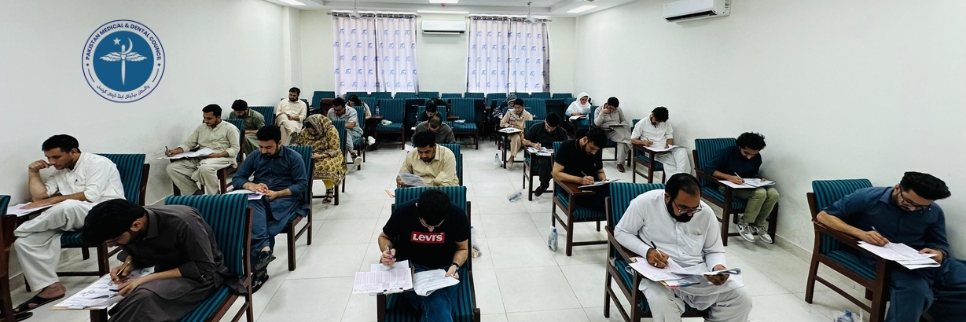
A formal definition of the MDCAT 2025 exam's format, weighting, and degree of difficulty has also been established. The exam will have 180 multiple-choice questions (MCQs) in total, and it will take three hours to finish. 15 percent of the questions will be easy, 70 percent will be moderate, and 15 percent will be difficult. There will be no negative marking, and the exam will be fully MCQ-based.
Candidates must receive a minimum of 55 percent for admission to medical schools and 50 percent for entrance to dentistry schools in order to be eligible for admission. These requirements have been set up to guarantee an impartial and thorough assessment of each applicant's knowledge and preparedness for study in medicine or dentistry.
The new MDCAT 2025 syllabus, according to a statement from PMDC President Prof. Dr. Rizwan Taj, is a step toward advancing openness, equity, and uniformity in medical and dental admissions.
According to him, the PMDC successfully handled the issue and unveiled the updated curriculum in just six months after a few flaws in the prior one were identified and fixed.
This revised curriculum was designed to meet the changing academic requirements of our next generation of healthcare professionals by striking a balance between fundamental knowledge and critical thinking and reasoning abilities.
The groundwork for a merit-based, centralized national evaluation is laid via an updated curriculum. With the help of experts, the PMDC is also creating a question bank, he said.
Dr. Taj emphasized that the council has worked hard to address these problems and guarantee an equitable testing system while acknowledging previous difficulties. He said that in order to bring the new curriculum into line with both international best practices and national academic standards, it was established after extensive consultations with education professionals, universities, and provincial authorities.
The MDCAT Committee has also finalized a uniform national curriculum for the test, in collaboration with its specialized working groups.
The committee and its working groups met nine times in order to develop and improve the curriculum.


