Girls dominate Karachi Board Pre-Engineering exams with top three ranks
- August 18, 2025
- 2262
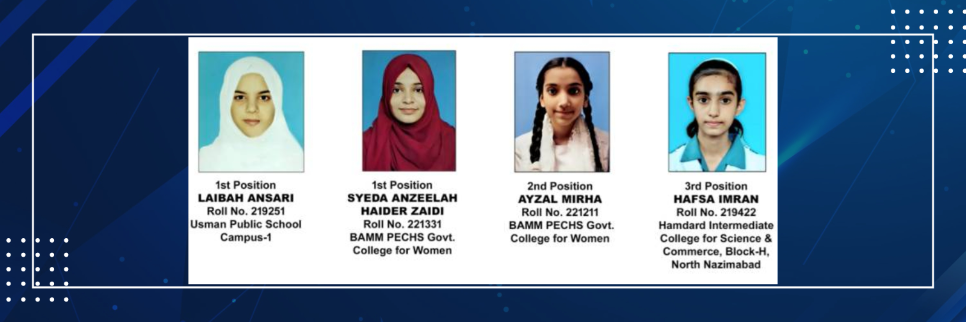
Board of Intermediate Education Karachi has officially released the results of the HSC Part-II (Class XII) Annual Exams 2025 for students of the Science Pre-Engineering Group.
The females outperformed the boys to earn the top first positions.
Fakir Muhammad Lakho, the chairman of the Karachi Board of Intermediate Education, announced the top contenders' places.
Students Laiba Ansari from Usman Public School and Syeda Anzila Haider Zaidi from BAMMPECHS Government College for Women shared first place.
The second place went to BAMMPECHS Government College for Women student Aizawl. Students from Block H of the Hamdard Intermediate College for Science and Commerce in North Nazimabad, including Hafsa Imran, came in third.
Only 11,547 out of the 21,019 applicants that took the examinations were deemed successful. Almost 45 percent of students did not pass the tests. The representative added that the results have been posted to the board's website.
China Introduces New Visa for Genius Students
China will launch a new K visa on October 1, 2025, with the goal of luring young scientists and IT workers from all around the world.
The program is a component of a larger endeavor to improve the nation's innovation ecosystem and facilitate the participation of highly qualified persons in China's scientific and technical advancement.
What's New?
China previously offered 12 primary visa types, such as employment (Z), study (X), business (M), and family reunion (Q) visas, per the 2013 Foreigners Entry-Exit Administration Regulations. A new category is added by the amendment:
K Visa: Given to young, talented foreigners in research and technology.
Eligibility: Candidates must fulfill the standards established by Chinese authorities and present the necessary paperwork.
In general, the phrase "young science and technology talent" describes:
The program welcomes young educators, researchers, and STEM graduates with a bachelor’s degree or higher from accredited universities worldwide.
Why the Shift?
China's Talent Power Strategy, which highlights innovation as a growth engine, talent as a vital resource, and science as a productivity driver, is in line with the K visa. It's intended to:
Lower obstacles to entrance for eligible people.
Encourage the interchange of science and technology worldwide.
Encourage partnerships that bolster China's efforts in innovation and research.
Prior to the launch, comprehensive instructions addressing application processes, necessary documentation, and the potential for entirely online submissions are anticipated from the Ministry of Foreign Affairs.
Additional incentives, including housing subsidies, startup funding, or access to innovation hubs, may be provided by certain locations to entice K visa holders.
A deliberate move in the worldwide race for talent in science and technology, the K visa is more than just a new category. It might establish China as a top location for the upcoming generation of academics, entrepreneurs, and innovators if it is carried out well.